
A Practical Toolkit for Whole-Life Career Design
This free workbook and course help you design your next career steps with your whole life in mind. Instead of being obsessed with “finding the one perfect job,” you use guided exercises to clarify what matters, map your current situation, and build a realistic direction through small, testable steps.
Assess your career self-management competencies!
The workbook
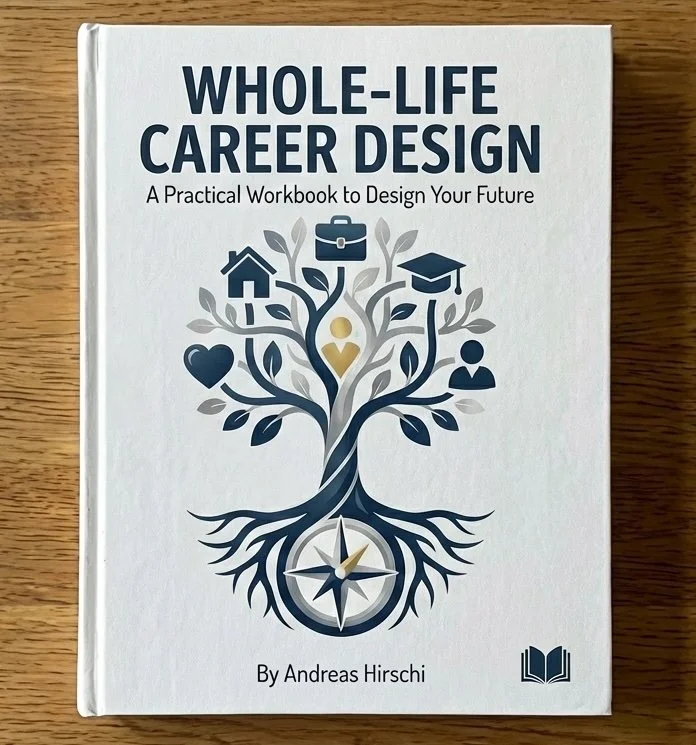
A research-based, practical guide that leads you through four action phases—clarifying goals, mapping resources and obstacles, planning and acting, and reviewing and adapting. The workbook outlines key concepts, practical exercises, and personal reflection prompts to help you design a sustainable career.
The online course
The online course below gives you short videos that explain the key ideas and guide you through a selection of the most important exercises. It’s a great option if you prefer learning with video or want a lighter entry point before going deeper with the workbook.
The exercise library
The exercise library is a helpful companion to the workbook. It explains every exercise in more detail—what it’s for, how to do it, and tips to get the most out of it—so you can work confidently on your own or with support.
Want to use this in your organization?
All materials are provided for free for personal use only. If you would like to bring these ideas and materials into a keynote, workshop, leadership program, counseling, or counselor training, please contact me or check out the usage policy for the framework.
WHOLE-LIFE CAREER DESIGN
Self-paced course
The world of work today is characterized by rapid change and uncertainty. Digitalization, automation, and shifting markets further increase this. This course provides the knowledge and skills to help you actively shape your career in a future-oriented way and adapt to ongoing changes.
This course is your companion on the path to discovering and shaping your professional and personal future. You will delve deep into career planning, explore your individual strengths and interests, and find ways to align them with your goals and values. With a mix of research-backed knowledge, reflective questions, and practical exercises, this workbook offers you the opportunity to actively shape your career.
Get ready to discover new horizons, realize your full potential, and create a path that promises not only professional success but also personal fulfillment.
Let's begin this exciting journey!
-
-
Chapter 1. The foundations
Learn why proactive, whole-life career design matters now—and how the four pillars and action phases turn uncertainty into clear, doable steps toward meaningful, sustainable work.
Learn why proactive, whole-life career design matters now—and how the four pillars and action phases turn uncertainty into clear, doable steps toward meaningful, sustainable work.
-
-
-
Chapter 2. Values and goals in career design
Values are enduring beliefs about what matters most to you and provide a stable compass for career and life decisions. In this chapter, you will explore how values shape meaning, resilience, and satisfaction, and how to translate broad value directions into concrete, motivating goals– while managing multiple goals across work and life roles.
Values are enduring beliefs about what matters most to you and provide a stable compass for career and life decisions. In this chapter, you will explore how values shape meaning, resilience, and satisfaction, and how to translate broad value directions into concrete, motivating goals– while managing multiple goals across work and life roles.
-
Chapter 3. The role of vocational interests in career design
Vocational interests are relatively stable preferences for certain activities and work environments. They provide direction, energy, and perseverance–and are especially useful when deciding between specific fields of study, roles, or occupational paths. In this chapter, you will clarify your interest profile, understand how interests and passion develop, and use the RIASEC model as a practical compass for exploring and evaluating career options.
Vocational interests are relatively stable preferences for certain activities and work environments. They provide direction, energy, and perseverance–and are especially useful when deciding between specific fields of study, roles, or occupational paths. In this chapter, you will clarify your interest profile, understand how interests and passion develop, and use the RIASEC model as a practical compass for exploring and evaluating career options.
-
Chapter 4. Skills in career design
Skills are a core engine of sustainable career development. They enable strong performance, make progress visible, and support goal achievement–strengthening self-efficacy and intrinsic motivation along the way. In this chapter, you will map your current skill mix, understand how skills contribute to person–job fit, and develop a practical approach for building the capabilities you need for the next phase of your career.
Skills are a core engine of sustainable career development. They enable strong performance, make progress visible, and support goal achievement–strengthening self-efficacy and intrinsic motivation along the way. In this chapter, you will map your current skill mix, understand how skills contribute to person–job fit, and develop a practical approach for building the capabilities you need for the next phase of your career.
-
Chapter 5. Exploring the world of work for informed career design
Career design requires more than self-knowledge. You also need an up-to-date, realistic understanding of roles, industries, education pathways, and entry routes. In this chapter, you will learn how systematic exploration reduces uncertainty, corrects faulty assumptions, and uncovers overlooked options. You will use a structured approach to broaden possibilities, research promising paths in depth, and evaluate options against personal fit and feasibility criteria
Career design requires more than self-knowledge. You also need an up-to-date, realistic understanding of roles, industries, education pathways, and entry routes. In this chapter, you will learn how systematic exploration reduces uncertainty, corrects faulty assumptions, and uncovers overlooked options. You will use a structured approach to broaden possibilities, research promising paths in depth, and evaluate options against personal fit and feasibility criteria
-
-
-
Chapter 6. Resources and obstacles in career design
Career development depends not only on good decisions, but also on the resources that make progress possible–and the obstacles that can derail plans if left unaddressed. In this chapter, you will map the resources you can actively build and leverage, understand how they interact in positive (or negative) spirals, and develop a practical approach for identifying barriers early and responding with targeted strategies.
Career development depends not only on good decisions, but also on the resources that make progress possible–and the obstacles that can derail plans if left unaddressed. In this chapter, you will map the resources you can actively build and leverage, understand how they interact in positive (or negative) spirals, and develop a practical approach for identifying barriers early and responding with targeted strategies.
-
-
-
Chapter 7. Develop plans and take action
In a dynamic and unpredictable world of work, effective career planning is less about creating a perfect long-term roadmap and more about setting a clear direction, running learning loops, and adapting as you gain information and experience. In this chapter, you will build practical action plans grounded in your values and goals, learn a core set of evidence-informed career management behaviors, and strengthen implementation so your plans translate into consistent progress.
In a dynamic and unpredictable world of work, effective career planning is less about creating a perfect long-term roadmap and more about setting a clear direction, running learning loops, and adapting as you gain information and experience. In this chapter, you will build practical action plans grounded in your values and goals, learn a core set of evidence-informed career management behaviors, and strengthen implementation so your plans translate into consistent progress.
-
-
-
Chapter 8. Review and adjust
Careers rarely unfold in a straight line. Regular review and adjustment helps you stay aligned with what matters most, avoid sticking to outdated plans, and make progress visible, especially when circumstances change. In this chapter, you will learn a structured review process, translate feedback into concrete adjustments, and build a sustainable routine for staying on track while remaining flexible.
Careers rarely unfold in a straight line. Regular review and adjustment helps you stay aligned with what matters most, avoid sticking to outdated plans, and make progress visible, especially when circumstances change. In this chapter, you will learn a structured review process, translate feedback into concrete adjustments, and build a sustainable routine for staying on track while remaining flexible.
-
-
-
Chapter 9. Conclusion – What have you learned?
Now that you have completed the Whole-Life Career Design Workbook, this chapter helps you consolidate your learning, integrate key insights across all phases, and translate your experience into clear implications for your next steps. You will review how your goals, resources, plans, and review routines have evolved, and strengthen your ability to carry these methods and competencies forward in future career transitions.
Now that you have completed the Whole-Life Career Design Workbook, this chapter helps you consolidate your learning, integrate key insights across all phases, and translate your experience into clear implications for your next steps. You will review how your goals, resources, plans, and review routines have evolved, and strengthen your ability to carry these methods and competencies forward in future career transitions.
-