
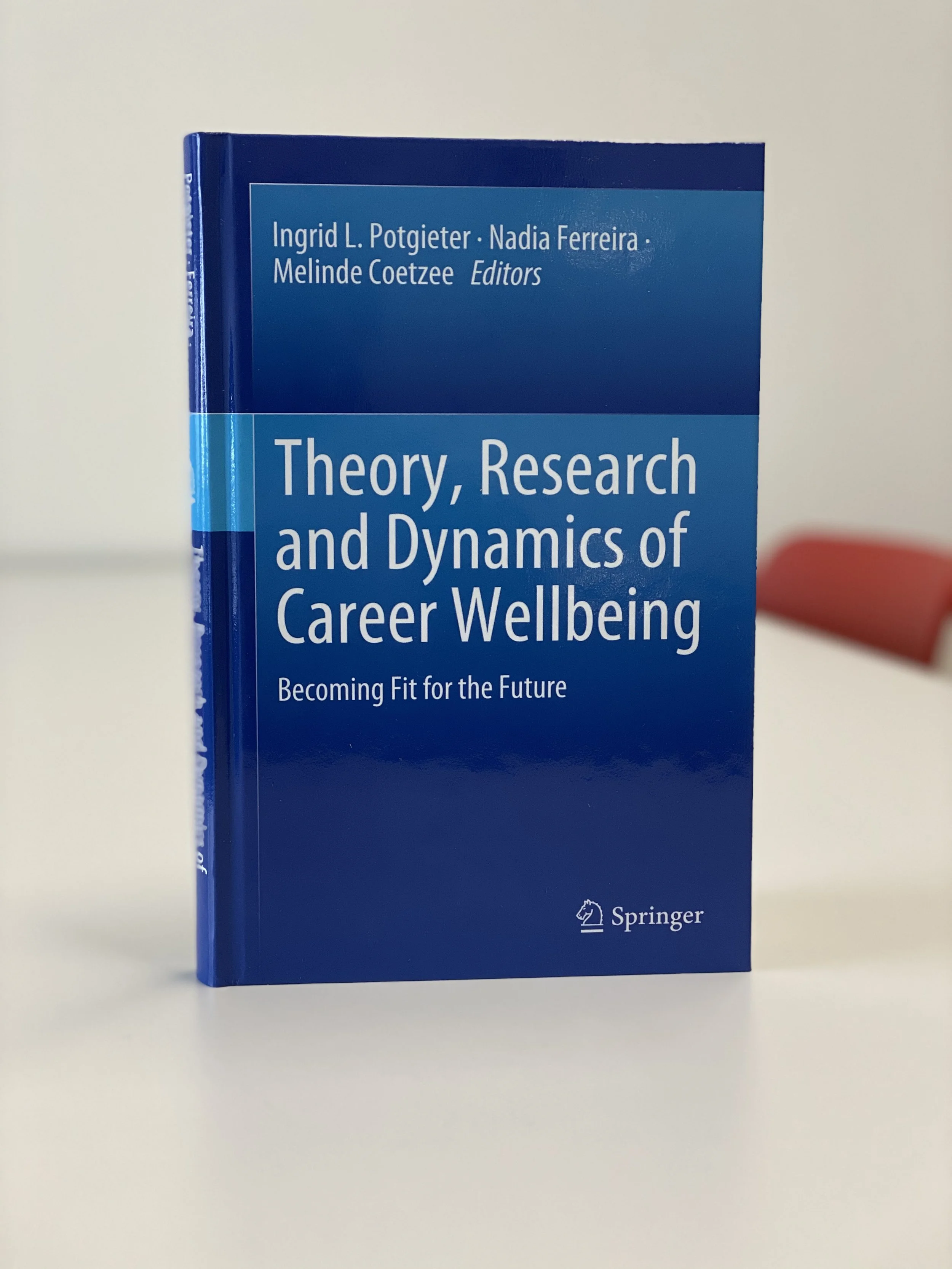
Career self-management as a key factor for career wellbeing
Wilhelm, F., & Hirschi, A. (2019). Career self-management as a key factor for career wellbeing. In I.L. Potgieter, N. Ferreira & M. Coetzee (Eds.). Theory, Research and Dynamics of Career Wellbeing (pp. 117-137). Switzerland: Springer.
Career self-management (CSM) is an important factor for achieving career wellbeing and is becoming increasingly crucial in career environments characterized by higher volatility, uncertainty, complexity, and ambiguity. In this chapter, we provide an overview of current research on CSM, and conceptually and empirically clarify its relation to career wellbeing. First, we define CSM and delineate its dimensionality. Second, we concisely summarize the empirical research on predictors and career wellbeing related outcomes of CSM. Third, based on our literature review, we suggest how CSM can be promoted through interventions, and how organizations can create synergies between organizational and individual career management. Finally, we suggest avenues for further research addressing identified research gaps: conceptual refinement, investigating facilitators of CSM at different action stages, broadening the scope of investigated career wellbeing outcomes of CSM, conducting theory-based intervention studies to systematically promote CSM, and examining contextual influences emerging in Industry 4.0 work-life spaces.
Vocational identity trajectories: Differences in personality and development of well-being
Hirschi, A. (2012). Vocational identity trajectories: Differences in personality and development of well-being. European Journal of Personality, 26(1), 2-12. doi: 10.1002/per.812
Abstract
This person-centred study investigated the longitudinal patterns of vocational identity development in relation to personality, the development of well-being, gender, nationality and the attended school track among two cohorts of Swiss adolescents in 8th or 9th grade (N ¼ 269) and in 11th or 12th grade (N ¼ 230). The results confirmed the existence of four identity statuses, namely, achievement, foreclosure, moratorium and diffusion. Forty two per cent of students showed progressive patterns of identity development, while 37% remained in their identity status over time. Students with different statuses and status change patterns differed significantly in their personality traits. Higher neuroticism related to the emergence of identity exploration over time, while conscientiousness related to maintaining or achieving a sense ofidentity commitment in terms of achievement or foreclosure. Controlling for the effects of socio-demographics and personality traits, students who reached or maintained a state characterized by identity clarity and commitment showed a relative increase in life satisfaction, while those entering a state of identity crisis or exploration showed a decrease in life satisfaction.
Keywords: vocational identity; career development; adolescence; personality; well-being